
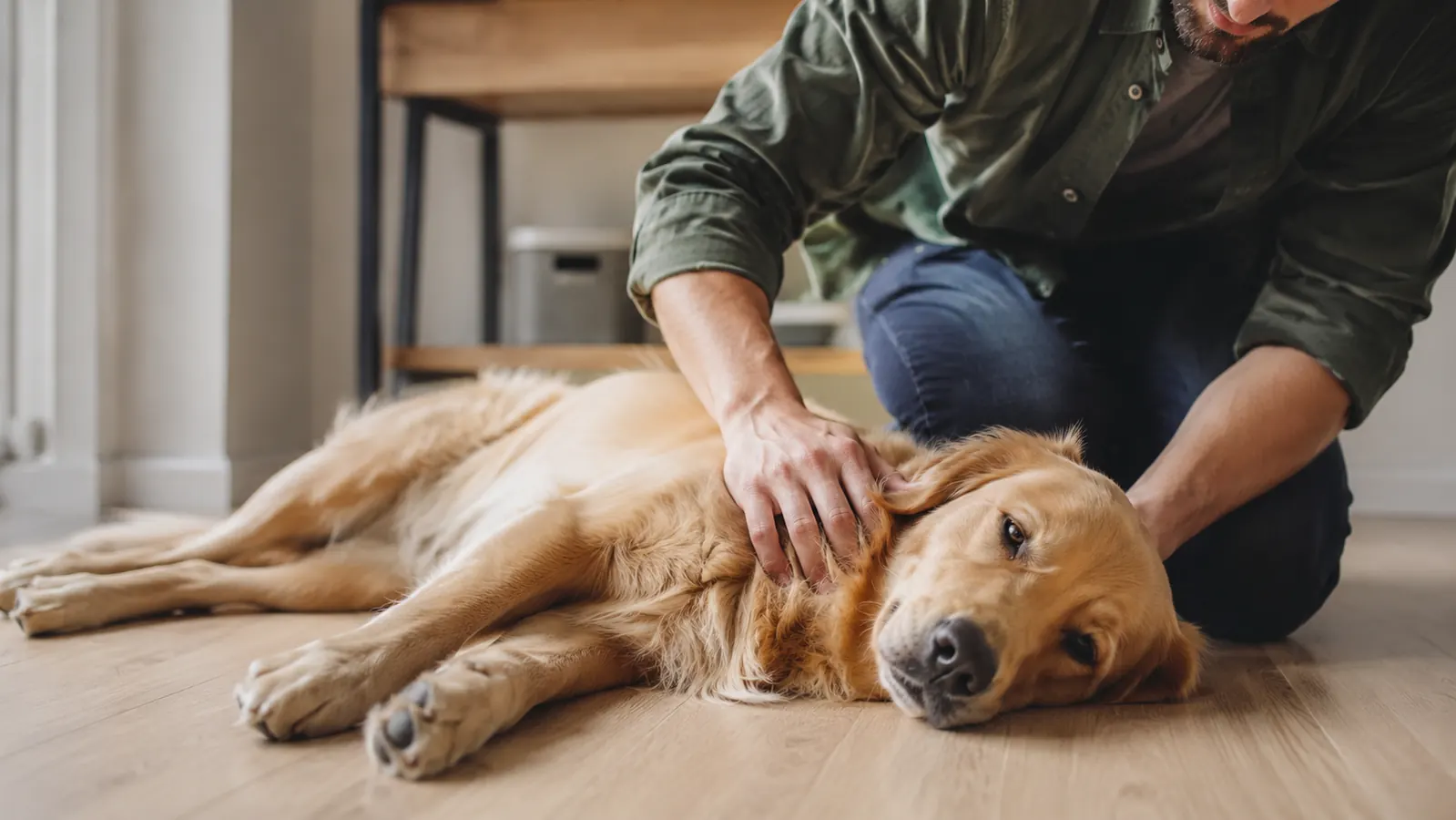
Most dogs who panic at nail time are not reacting to nail trims. They are reacting to the click and crack of clippers, the pressure on the nail, and the memory of the one time the quick got nicked and it hurt. My own dog, a three-year-old Border Collie mix named Clover, used to bolt under the bed the moment she spotted the clippers. It took two people and a whole lot of treats just to get one paw. That went on for almost a year before I switched to an electric nail grinder.
The grinder itself is only part of the solution. The bigger shift is how you introduce it. A grinder that gets shoved onto a nervous dog's nail on day one will just create a new kind of panic. But a grinder introduced slowly, on the dog's terms, with plenty of rewards, can turn nail trim day from a battle into a routine that takes ten calm minutes. This guide walks through exactly that process, step by step, using the Casfuy 2-Speed Whisper-Quiet Nail Grinder as the tool of choice.
Your dog's nails are too long and the clippers aren't working. Here is the tool that changes that.
The Casfuy nail grinder runs on two quiet speed settings, has a protective guard for beginners, and charges via USB. Over 100,000 pet owners have rated it 4.5 stars. Check today's price on Amazon before starting Step 1.
Amazon Check Today's Price on Amazon →Step 1: Let the Grinder Live in the Room for Three Days
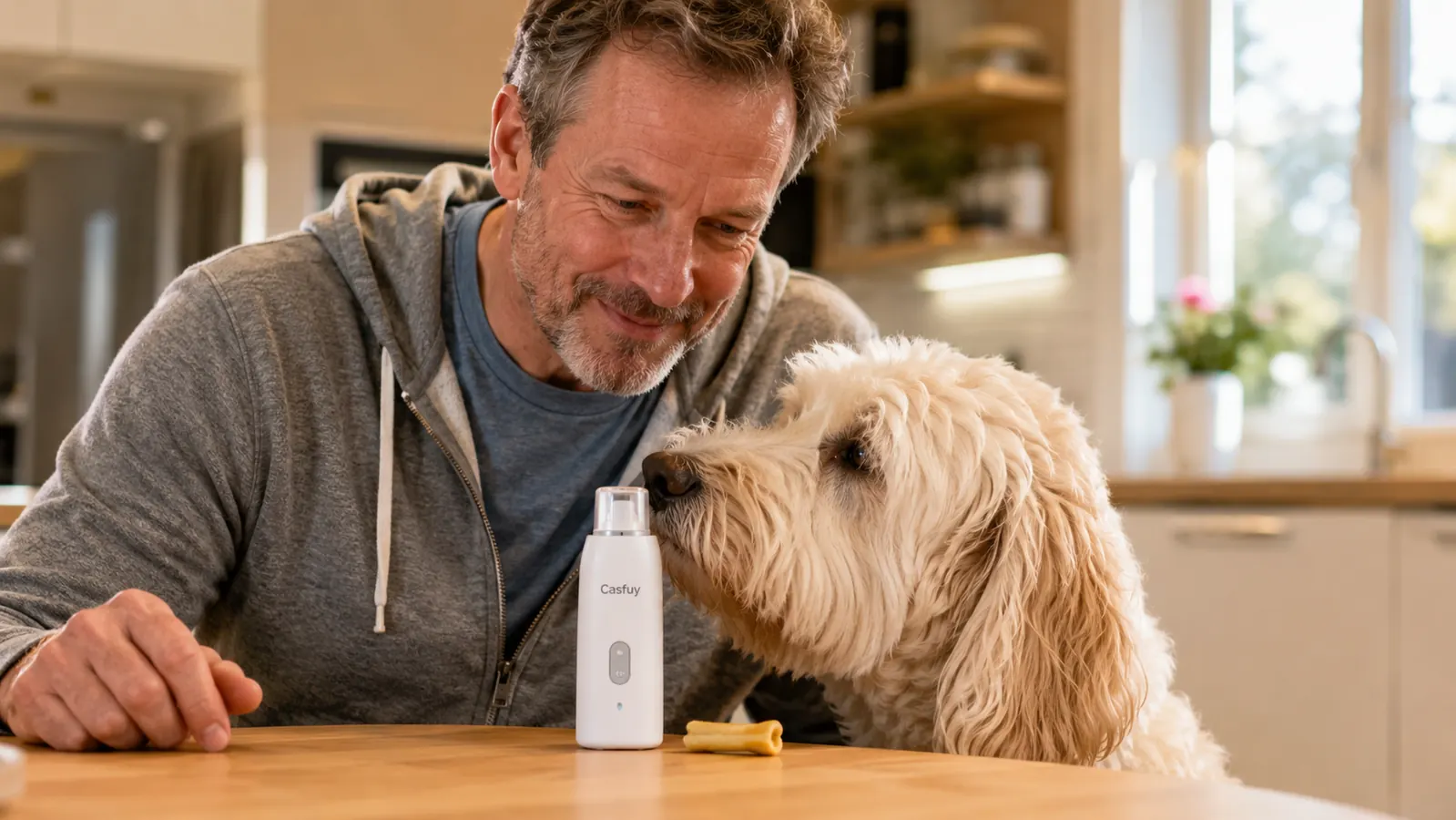
Before the grinder ever touches your dog, it needs to stop being a scary unknown object. The first thing I did with Clover was set the Casfuy grinder on the coffee table where she could see and sniff it on her own. No turning it on, no reaching for her paws. Just the grinder sitting there while we went about our day. I put a few small treats next to it so that sniffing the area became self-rewarding.
By day two, Clover was sniffing the grinder directly without any stiffness or backing away. By day three, she barely acknowledged it. That is the goal of this step. A curious dog is a ready dog. A dog who still flinches when you reach toward the grinder needs another day or two at this stage before you move on. Do not rush past it. The time you invest here is time saved in every future session.
If your dog is extremely anxious, you can also feed meals near the grinder, a few feet closer each day, until they are eating comfortably right beside it. Positive association before any pressure is what separates a dog who tolerates nail grinds from one who genuinely settles for them.
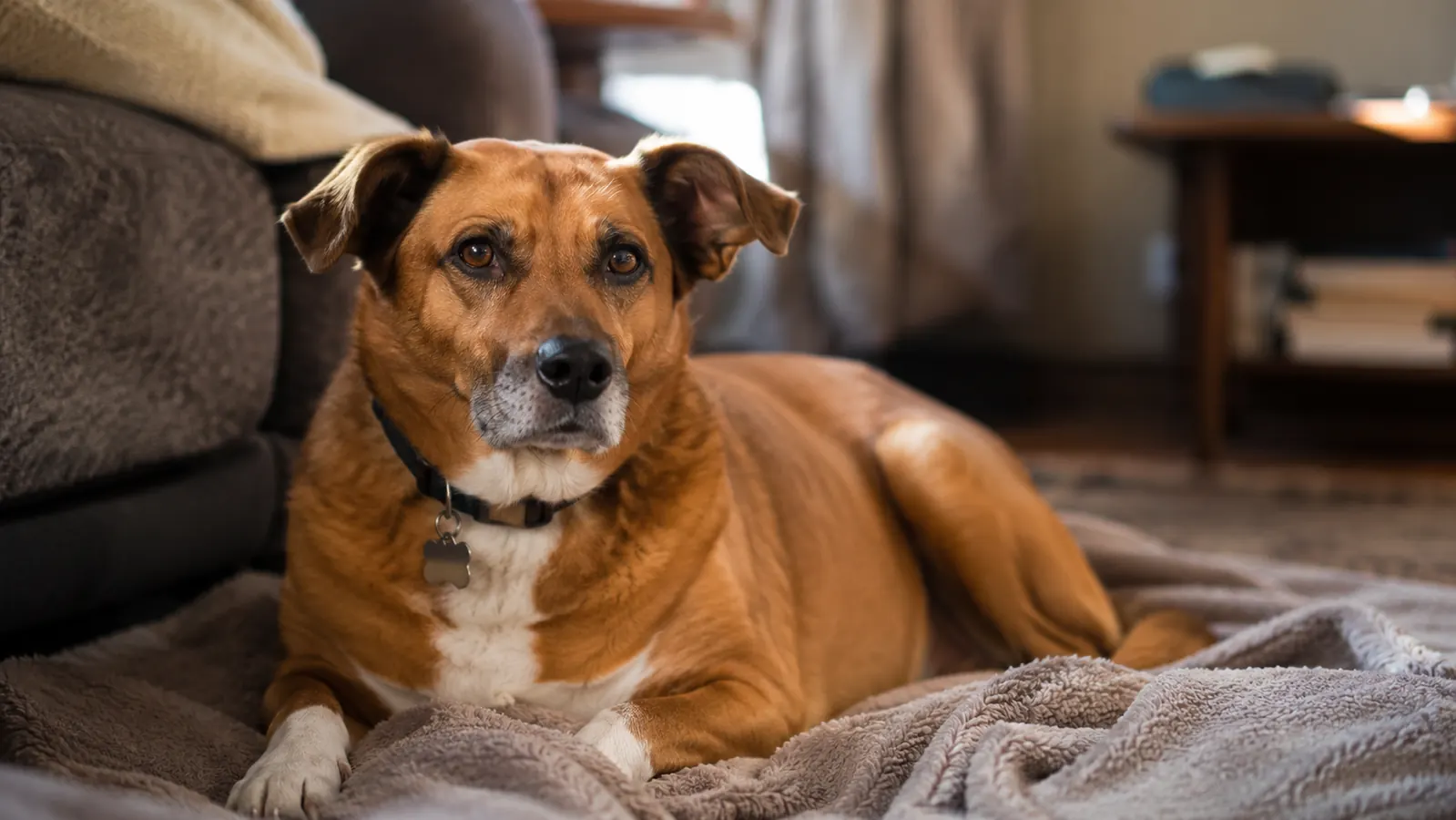
Step 2: Turn It On and Let Your Dog Hear It From a Distance
The Casfuy grinder is marketed as whisper-quiet, and compared to most grinders I have used, it earns that description. But any motorized sound is new to a dog who has never heard one up close. The second step is sound desensitization. Turn the grinder on at low speed, set it down on the floor across the room, and go about your business. Toss a few treats in your dog's direction while it is running, but do not make a big production of it.
Watch your dog's body language. Ears pinned back, tail tucked, or moving away from the room means you need more distance and more time at this stage. Ears perked with mild curiosity, or ignoring the sound entirely, means you are good to move closer tomorrow. Over two or three short sessions, work the running grinder gradually closer until your dog can be in the same immediate space as the running grinder with a relaxed body.
Keep every session under five minutes at this stage. You are not training duration, you are building a neutral association with the sound. Short, positive, and done before the dog has any reason to get uncomfortable.
Step 3: Touch the Grinder to the Paw Before You Touch Any Nail
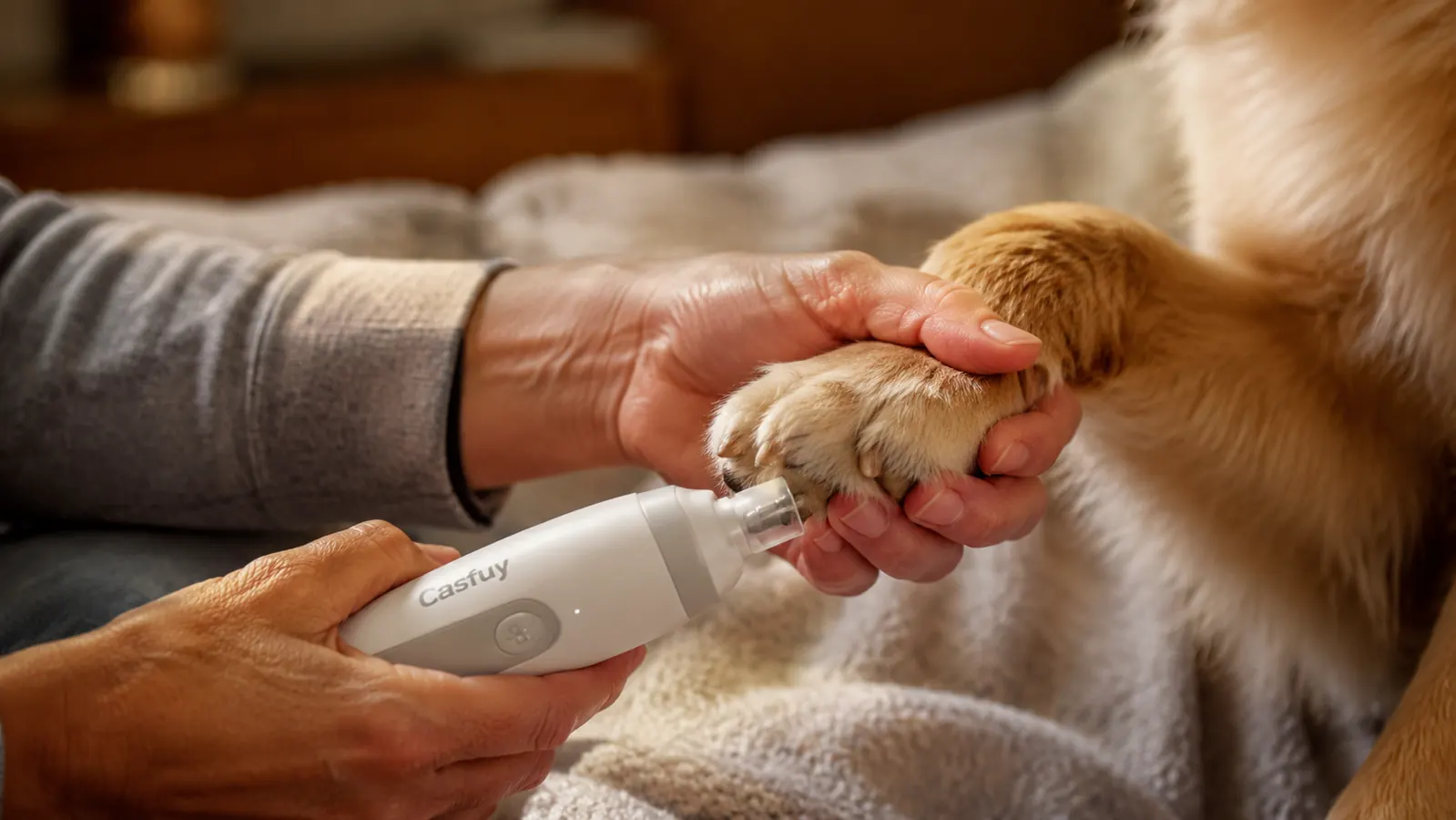
This step is where most people skip ahead and undo their progress. The dog is fine with the sound, so the assumption is that they are ready for a nail grind. They might be. But the vibration of the grinder against the paw is its own new sensation, and you want to introduce that separately. Turn the grinder on at low speed and touch the flat side of the guard gently against the top of your dog's paw, not the nail, just the fur on top of the foot. Reward immediately.
Do this for five to eight repetitions across two or three sessions. The goal is a dog who lets you hold the running grinder against the paw without pulling away. Once that is solid, shift the contact to the side of the nail without actually grinding. You are letting the dog learn that the vibration on the nail is not painful. A treat the moment the grinder touches the nail, every single time, builds the connection fast.
The Casfuy's protective grinding guard is genuinely useful here because it limits how much of the nail you can accidentally contact in a single pass. For nervous dogs and nervous owners both, that guard is a confidence tool. You can move it aside once you have the technique down, but in these early sessions, leave it on.
Step 4: Grind One Nail, Reward, Stop for the Day
The first real grinding session should be deliberately underwhelming. One nail. That is it. Pick the least sensitive nail on the most cooperative paw. Set the Casfuy to low speed. Bring the grinder to the nail tip and grind for two or three seconds max, working from the underside to avoid the quick. Give your dog a high-value treat immediately, then end the session with praise and a play break. You are done for the day.
The reason to stop after one nail is that you want the dog's last memory of the session to be positive, before any fatigue, restlessness, or discomfort has a chance to build. Dogs do not generalize the way we do. If the last thing that happened was good, the next session starts with a slightly higher baseline of comfort. If you pushed through all four paws on day one and the dog got squirmy and stressed by the end, that stress is what carries forward.
Build up gradually over the course of a week or two. Two nails, then four, then one full paw, then two paws, then a complete session. Each increment should feel easy, not like a stretch. If your dog starts showing resistance at any level, drop back one step and spend another day there.
Step 5: Build a Consistent Routine With the Right Length Goal
Once your dog is accepting a full nail session, the job is to maintain consistency. Weekly grinding sessions keep nails at a comfortable length and also keep the quick receding over time if the nails were already too long when you started. A quick that has grown forward from months of infrequent trims will not move back in a week. It retreats about a millimeter every time you grind the nail tip off consistently, which is why staying on a weekly schedule matters for the first two to three months.
On the Casfuy, I use low speed for the first pass on each nail and switch to high for the final smoothing on harder nails. The two-speed option is worth using intentionally rather than just picking one and leaving it there. Low speed runs cooler on the nail, which matters because heat buildup from grinding too long in one spot is one of the few ways you can cause discomfort with a grinder. Keep each contact point to three seconds or less, pull away, check the nail, go again.
End every session with something the dog enjoys. For Clover it is a short tug session. For some dogs it is a handful of kibble, or a run in the backyard. The reward after the whole session tells the dog the entire event was worth showing up for. Within four to six weeks of this routine, most dogs that once panicked at clippers will walk over and sit down when they see the grinder come out. It sounds too good to be true, but the consistency of the association is what drives it.
What Else Helps
A few things make the process faster and smoother regardless of which step you are on. First, tire your dog out before the session. A ten-minute walk or a fetch session before you start means a calmer, more manageable dog. Second, find the treat that actually motivates your dog at a high level. Some dogs work for kibble. Most do not. Small pieces of chicken, cheese, or commercial training treats with a strong smell work far better for anxiety-prone dogs. Third, position matters. I work with Clover lying on her side on a towel, which naturally exposes all four paws and keeps her from getting up and circling. Some dogs do better sitting. Try both and watch which position keeps them most relaxed.
If your dog has black nails where the quick is not visible, grind in very small increments and watch for a small dark dot to appear at the center of the nail tip when you look at it straight on. That dot is your signal that you are close to the quick and should stop. The Casfuy's lower speed setting is especially useful for dark nails because it gives you more control over exactly how much material you are removing per pass. For a more detailed look at how this grinder performs over time and on different dog sizes, see the Casfuy nail grinder long-term review. And if you are still deciding between a grinder and clippers, the nail grinder vs clippers comparison breaks down the safety and stress differences side by side.
Within four to six weeks of a consistent weekly routine, most dogs that once bolted from clippers will walk over and sit when they see the grinder come out. Consistency is the whole thing.
Ready to make nail trims something your dog stops dreading? Start with the right tool.
The Casfuy 2-Speed Nail Grinder is quiet enough to use during desensitization, controlled enough for beginners, and proven across more than 100,000 owners. It is the tool this whole guide is built around. Check today's price and see if it is still in stock.
Amazon Check Today's Price on Amazon →