

If your dog finishes a full bowl of kibble before you have even put the bag away, you already know the problem. The gulping, the gagging, the post-meal bloat that makes their belly feel like a drum. My 4-year-old Lab mix, Biscuit, weighed 72 pounds and could clear a standard bowl in under 25 seconds. Then came the vomiting. Not once. Not twice. Regularly, right after meals, because she was taking in air faster than she could process food.
Fast eating is not just a quirk. In large and deep-chested dogs it raises the risk of bloat, also called gastric dilatation-volvulus, which can be fatal without emergency surgery. In smaller dogs it causes chronic regurgitation, poor nutrient absorption, and a habit that compounds over time. The fix is not complicated, but some solutions work far better than others. Here are six methods ranked from least to most effective, with the one I actually rely on every single day.
Still watching your dog inhale every meal? This $10 bowl adds four minutes to mealtime without any training.
The Outward Hound Fun Feeder Slo Bowl has 134,000-plus reviews and a 4.6-star rating because it works immediately, on the first use, with no adjustment period. It is the tool most vets point to for fast eaters.
Amazon Check Today's Price on Amazon →Step 1: Audit the Bowl and the Feeding Spot (Free, Do This First)
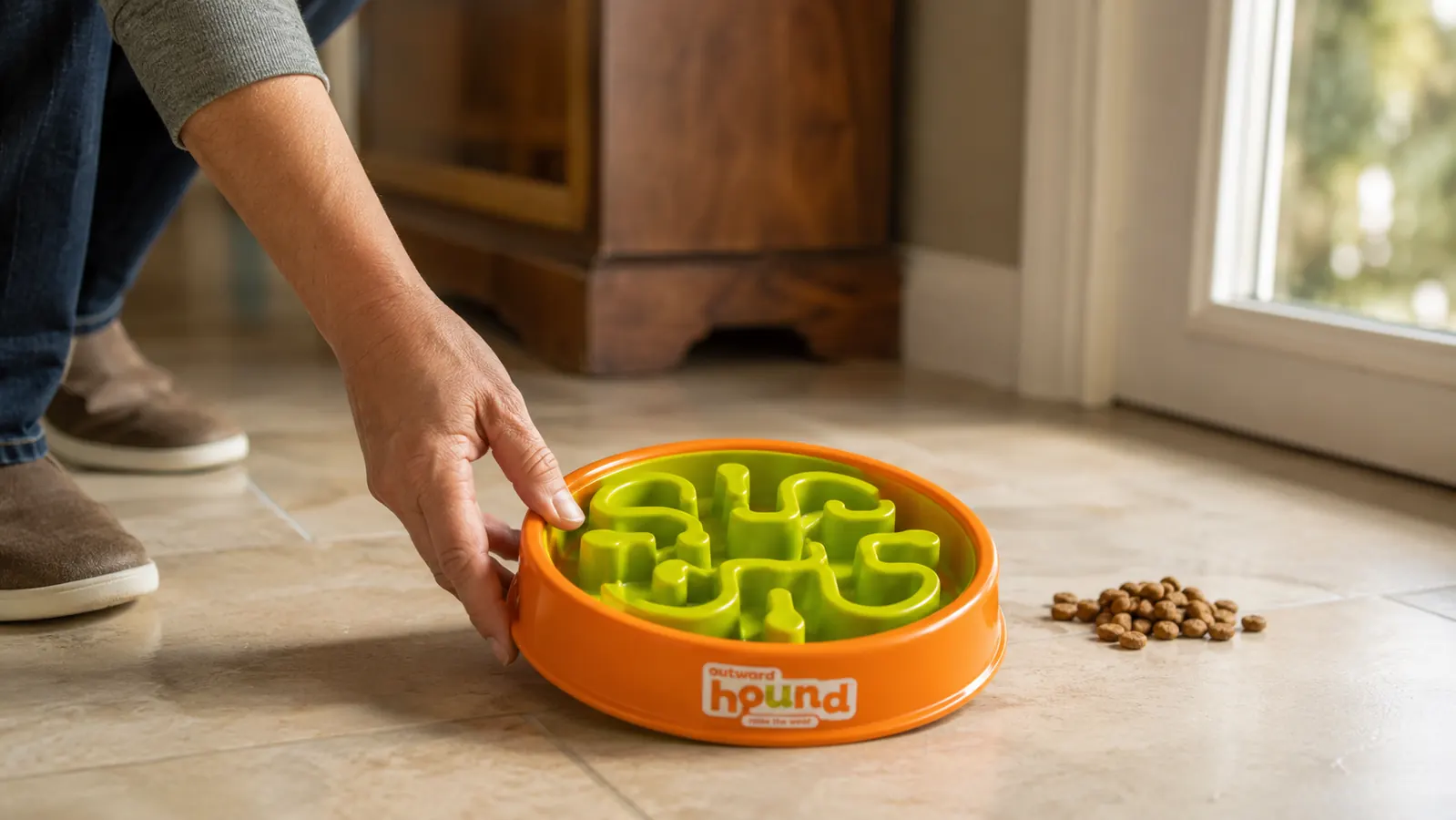
Before you buy anything, remove two common triggers. First, the bowl size. A wide, shallow bowl lets a dog drop their whole face in and scoop huge mouthfuls with minimal effort. Switching to a smaller, narrower bowl forces a slightly slower pace. It is not a complete solution, but it costs nothing and takes 30 seconds.
Second, check where you feed your dog. If you have multiple pets and feed them in the same room, competition anxiety is almost certainly making the gulping worse. Your dog is not just eating fast because of habit. They are eating fast because they are afraid someone else will get to the bowl. Feeding in separate rooms, or at least separate corners with visual barriers, removes that competitive pressure. For some dogs, this single change cuts mealtime speed noticeably.
These two adjustments take maybe five minutes and cost nothing. Do them first. They will not fully solve a serious gulper, but they address environmental factors that undermine every other method you try. If competition anxiety is the root cause, separating dogs at mealtimes may be the most important thing you do.
Step 2: Split Meals Into Smaller Portions (Low Effort, Moderate Impact)
Instead of one large meal, divide the same daily amount into two or three smaller servings. If you currently feed once a day, try twice. If you feed twice, try three smaller portions. A dog presented with a smaller amount of food simply has less to gulp in one sitting, which reduces the total air intake per meal even if the eating speed itself does not change.
Portion splitting pairs well with an automatic timed feeder if your schedule is inconsistent. Set it to dispense a measured amount at set times and your dog stops anticipating one big meal and stress-eating through it. The downside: you still have a fast eater at each sitting, just with less volume per session. Splitting meals addresses quantity but not behavior. It is method two for a reason.
Step 3: Try the Tennis Ball Trick and Other DIY Obstacles (Works, But Has Limits)
This one gets passed around a lot in dog forums: put a large, clean tennis ball or a smooth river rock in the center of the bowl. Your dog has to eat around it, which physically slows the pace. It works. I tried it with Biscuit for about three weeks and mealtime went from 22 seconds to roughly 90 seconds, which is real progress.
The problems: the ball slides around and frustrates some dogs, especially ones who start pawing at the bowl. Cleaning a bowl with a ball rattling around in it is annoying. And the obstacle has no grip, so it moves with every nudge. Some dogs learn to work around it quickly and speed creeps back up. It is a solid free option if you already have a tennis ball, but it tops out faster than a purpose-built tool.
A muffin tin or ice cube tray works on the same principle. Distribute kibble across 12 muffin cups and let your dog work each cup individually. More surface area, more individual bites, longer total mealtime. This works best for small-to-medium dogs. Large dogs can clear a muffin cup in one lick and feel frustrated rather than engaged.
Step 4: Introduce the Outward Hound Fun Feeder Slo Bowl (The Method That Actually Stuck)
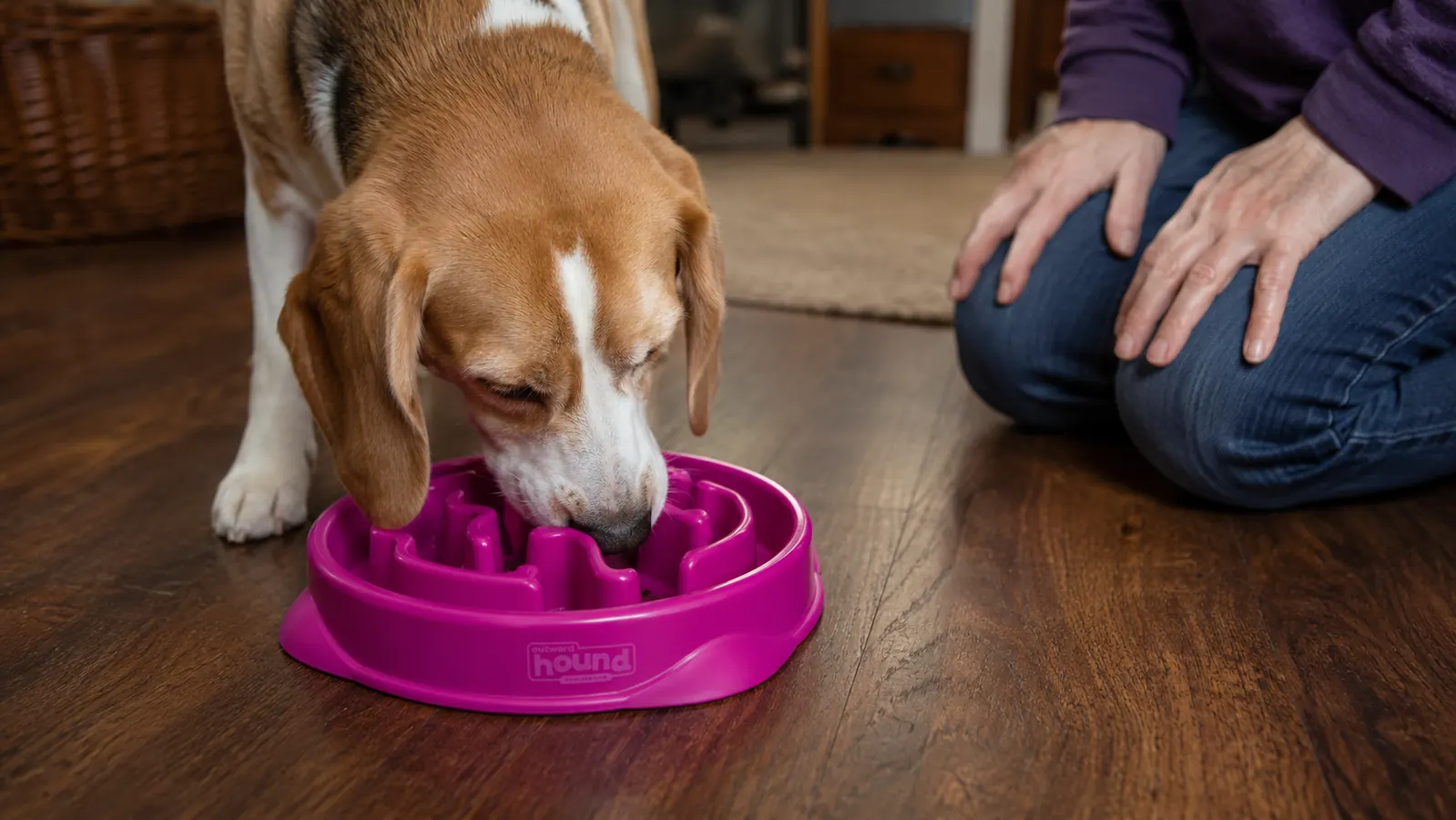
A slow feeder bowl with a raised maze pattern is the tool that made a lasting difference for Biscuit. The Outward Hound Fun Feeder Slo Bowl has ridges, channels, and raised nubs that force a dog to use their nose and tongue to work kibble out of individual pockets rather than scooping. The design does the work for you. There is no training required, no setup, no ongoing adjustment.
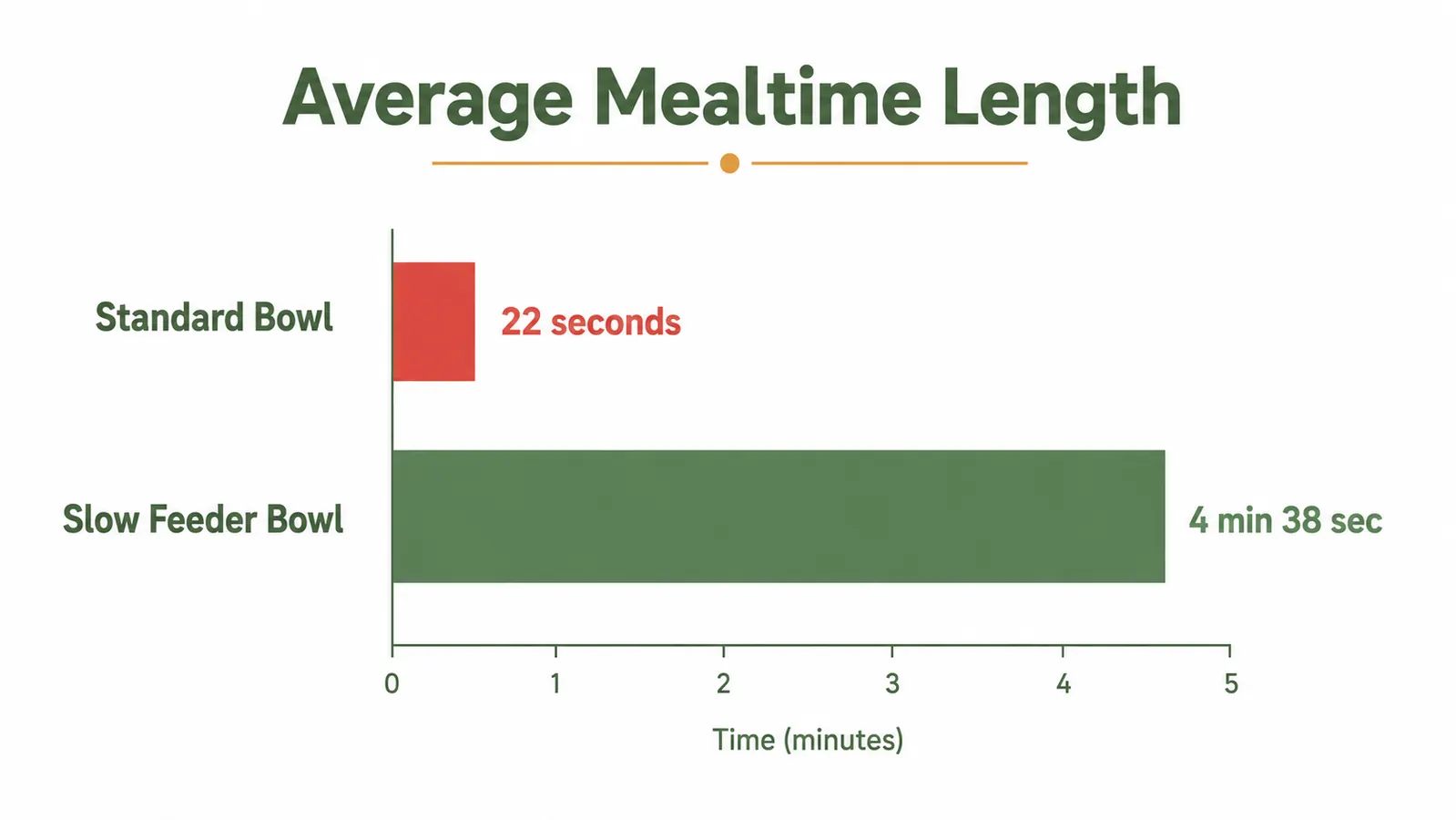
On the first use, Biscuit went from 22 seconds to 4 minutes and 41 seconds. I timed it. I stood there in mild disbelief. The kibble pockets were small enough that she had to take single pieces at a time, which meant she paused between bites, which meant she started swallowing between bites, which meant no air gulping. The post-meal drum belly that had become normal for her stopped happening within the first week.
The bowl holds up to 2 cups of dry kibble in the medium size, it is dishwasher safe, and it has a non-slip base that actually works on tile and hardwood. At current pricing it runs under $10, which makes it one of the most cost-effective health investments you can make for a fast-eating dog. With over 134,000 ratings at 4.6 stars on Amazon, the sample size here is not small. Read the full breakdown in the Outward Hound Fun Feeder long-term review if you want more detail on durability and sizing.
Step 5: Use Scatter Feeding or a Snuffle Mat for Enrichment-Based Slowing
Scatter feeding means spreading kibble across a flat surface, like a mat, a patch of grass, or a lick mat with textured pockets, and letting your dog sniff it out piece by piece. It is one of the most mentally engaging ways to serve a meal and one of the slowest. Dogs use their nose to locate each piece individually and there is no way to scoop a mouthful from scattered kibble.
A snuffle mat takes this further. The long fabric strips hide kibble in a way that requires sustained sniffing and nosing. Mealtime can stretch to 10 or 15 minutes with a good snuffle mat, which also burns mental energy before the meal settles. This is especially useful for high-drive dogs who tend to be anxious eaters. The comparison between slow feeder bowls and snuffle-style mats is worth understanding if you want to pick the right tool for your specific dog. See the slow feeder bowl vs licki mat comparison for a side-by-side breakdown.
The main limitation with scatter feeding and snuffle mats is mess and cleanup. Kibble ends up under furniture. The mat needs shaking or washing regularly. If your dog is also a chewer, some fabric snuffle mats get destroyed in the first week. Know your dog before investing in a snuffle mat.
What Else Helps
Raised bowls get mentioned often for large dogs but the research is actually mixed on whether elevated feeders help or worsen bloat risk. If your vet has specifically recommended a raised feeder for your dog, follow that advice. Otherwise, do not assume elevation alone slows eating or reduces bloat risk.
Feeding schedule consistency matters more than most people realize. Dogs who are fed at the same time every day tend to be calmer at mealtimes because there is no uncertainty about when food is coming. A dog who gets fed at random times stays in a low-level state of food anxiety that makes gulping worse. Set a schedule and stick to it.
Wet food or food with a higher moisture content naturally slows eating because dogs cannot scoop it as efficiently as dry kibble. If your dog is on a dry-only diet and you want to add a small amount of water or low-sodium broth to their kibble, that slight slurry effect can extend mealtime by 30 to 60 seconds without any gear at all. It is not dramatic but it is easy.
Finally, keep the post-meal rest rule. No running, jumping, or rough play for at least 30 minutes after eating. This holds for any dog, but especially large and deep-chested breeds. Even if you have slowed the eating speed, the stomach still needs time to settle. A slow feeder plus a calm 30-minute post-meal window is the combination that consistently works.
On the first use, Biscuit went from 22 seconds to 4 minutes and 41 seconds. The post-meal drum belly that had become normal for her stopped happening within the first week.
The fastest fix for a dog who inhales food is already in 134,000 kitchens.
The Outward Hound Fun Feeder Slo Bowl works on day one. No training, no setup, no guesswork. Under $10, dishwasher safe, and built to hold up to a dog who takes mealtime seriously. If your dog is still gulping, this is the place to start.
Amazon Check Today's Price on Amazon →