
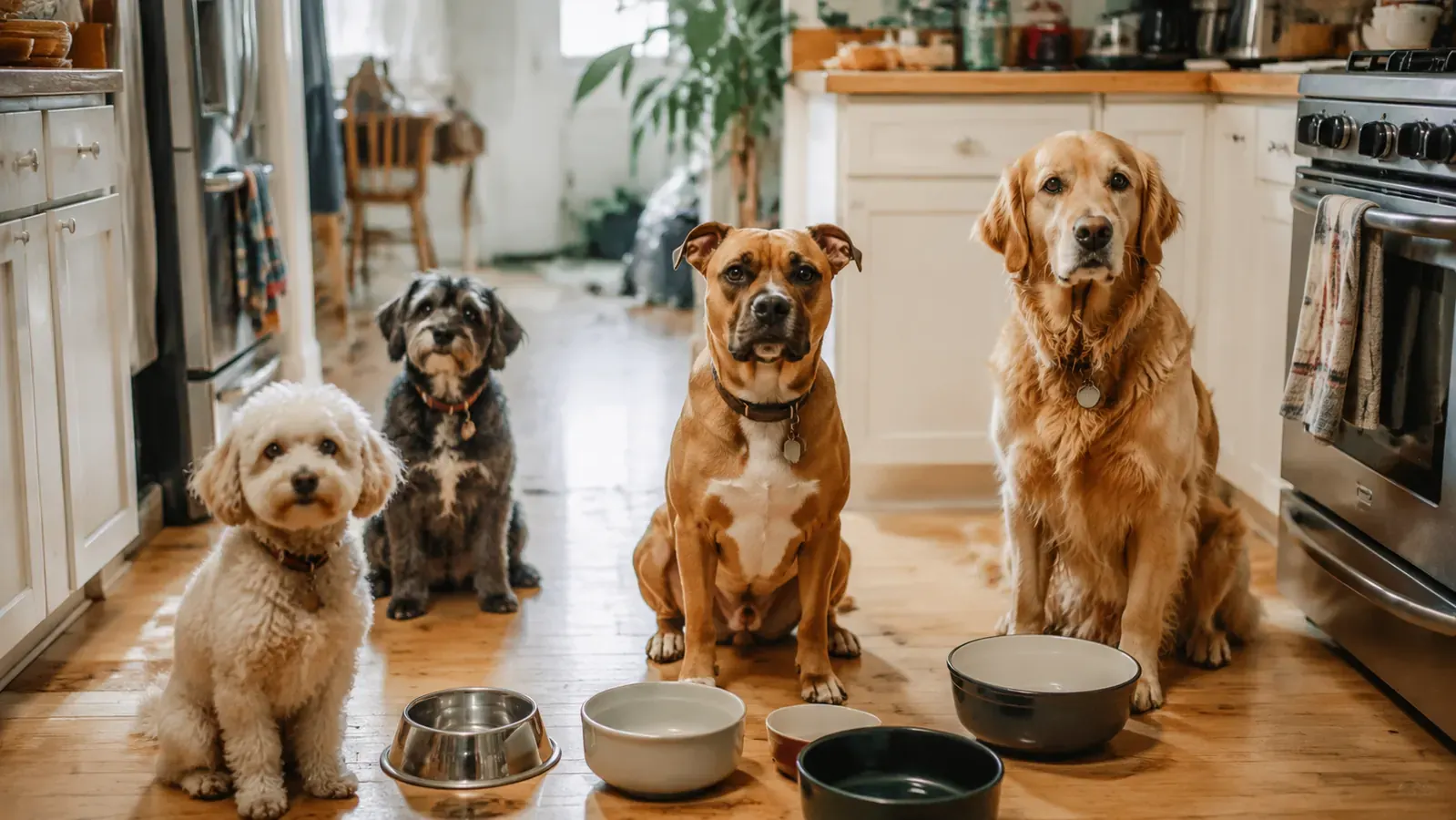
I want to tell you the thing the Amazon listing does not. The Outward Hound Fun Feeder Slo Bowl works. It genuinely slows dogs down at mealtime. But there are four things about this bowl that I figured out the hard way, and I want to put them in front of you before you buy. We ran it through four dogs over six weeks: Biscuit, a 28-pound Beagle; Rosie, a 55-pound Lab mix; Tank, a 62-pound American Pit mix; and Wren, a 9-pound Chihuahua mix. Their reactions ranged from problem solved to bowl-flipping indignation.
None of the things I am going to tell you are dealbreakers. But they are the stuff that shows up in the one-star reviews when people feel like they were not warned. You deserve to know them upfront.
The Quick Verdict
A genuinely effective slow feeder that cuts gulping time dramatically for medium and large dogs, with real caveats around cleaning effort, maze difficulty for small dogs, and bowl stability for determined movers.
Amazon Check Today's Price →If your dog clears a bowl in under 30 seconds, this is the fix.
The Fun Feeder Slo Bowl is under ten dollars and has slowed down over 130,000 dogs for owners on Amazon. It is not magic, but it is cheap, food-safe, and backed by a number that matters: 134,837 ratings at 4.6 stars.
Amazon Check Today's Price on Amazon →How We Used It: The Setup
All four dogs were fed their regular kibble in the Fun Feeder for six weeks straight. We used the medium size (2-cup capacity) for Biscuit, Rosie, and Tank. For Wren, we used the same medium bowl because there is no smaller option in this pattern, which turned out to be relevant. We timed meals with a phone stopwatch on the first and last day of each week. We hand-washed after every meal the first two weeks, then switched to the dishwasher for weeks three through six to see how it held up.
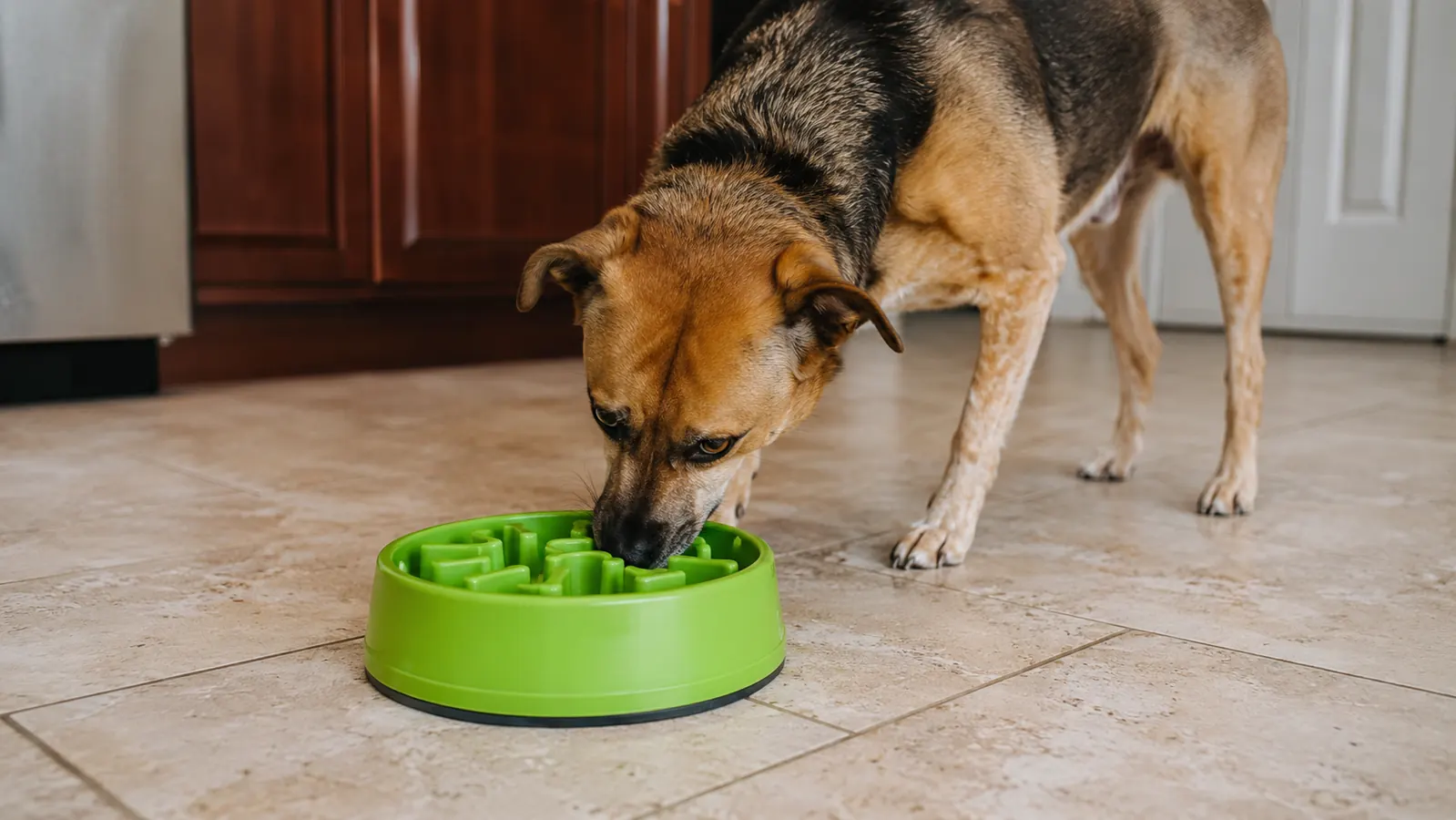
Baseline mealtime before the bowl: Biscuit, 22 seconds. Rosie, 31 seconds. Tank, 18 seconds. Wren, 47 seconds. Wren was actually the slowest eater to begin with, which matters later. The bowl is the medium Flower pattern, which has a moderate maze depth, not the most aggressive option Outward Hound makes but not the easiest either.
The Thing Nobody Warns You About: Cleaning the Grooves
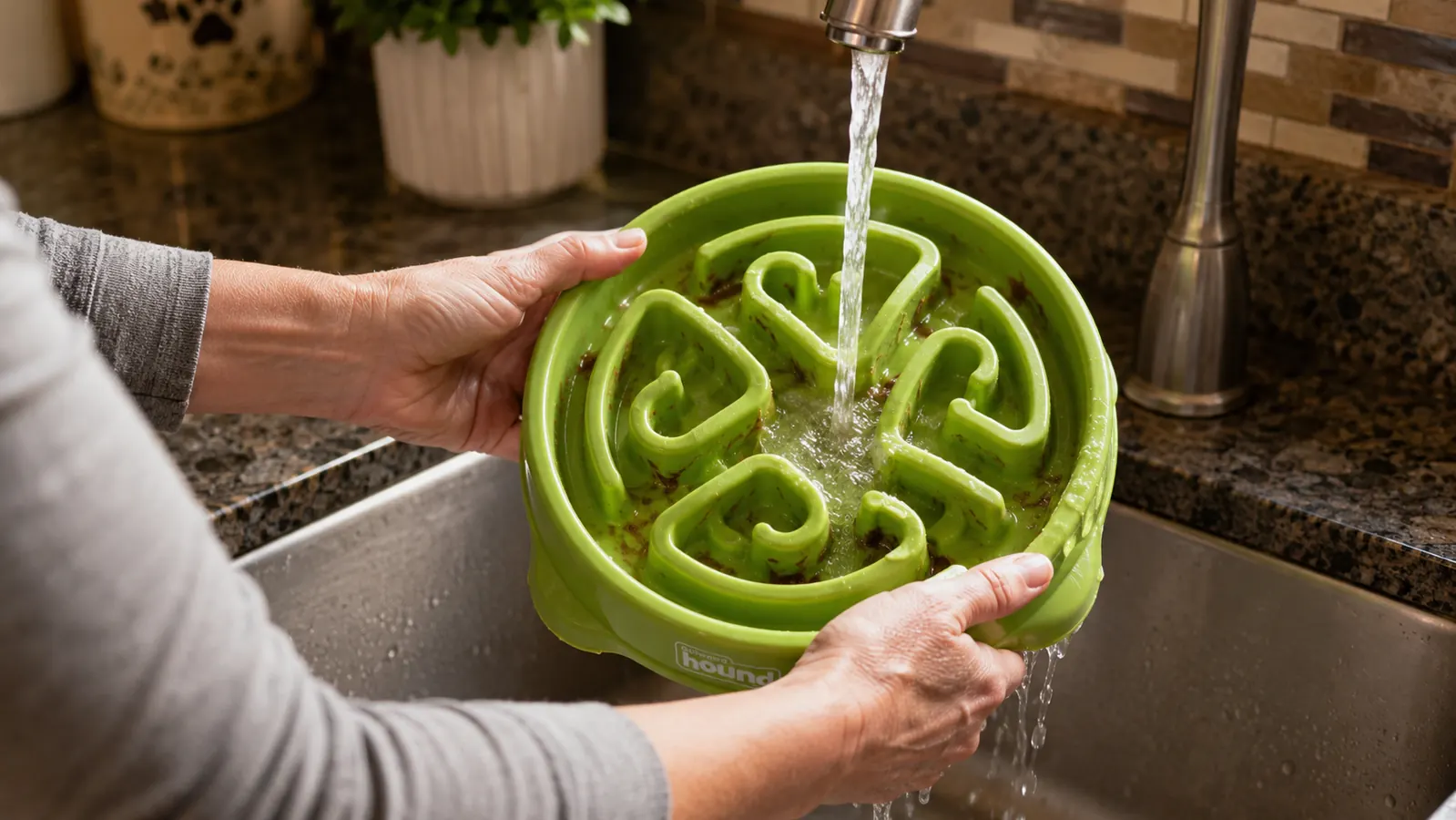
This is the one. The Fun Feeder bowl has raised ridges forming a flower or spiral pattern depending on which design you buy. Kibble and moisture get wedged into the crevices at the base of those ridges. If you are hand-washing, you need a bottle brush or a firm dish brush with a narrow head. A regular dish sponge will not reach the bottom of those grooves. After a wet food meal or even just kibble that has been sitting in a damp bowl, the gunk that collects in there is genuine. I am not saying this to be dramatic. I am saying it because nobody in the listing photos shows you a used bowl, and first-time buyers who rinse and swipe are going to be leaving bacteria behind.
The fix is simple: a bottle brush and a 60-second scrub. Or the dishwasher, which is the better answer anyway. But you need to know going in that this bowl requires a little more intention than a flat dish. If you have a dog who gets wet food toppers or raw food, bump that cleaning priority up considerably.
Dishwasher Reality: What Actually Survives
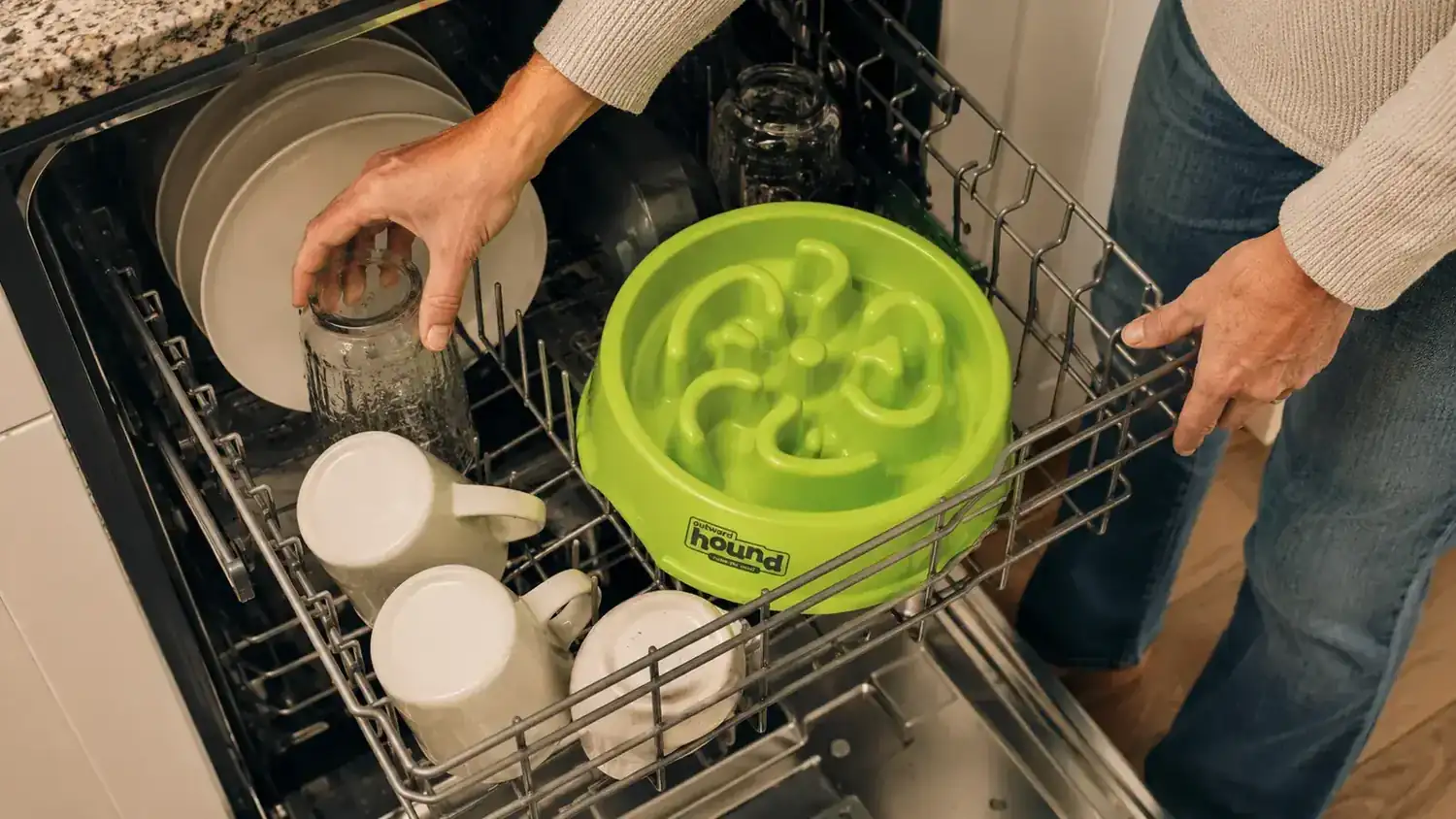
Good news here. The bowl is listed as dishwasher-safe on the top rack and it held up through four weeks of daily dishwasher cycles without warping, discoloring, or losing any structural integrity. The plastic is BPA-free and food-grade, and the color stayed consistent across six weeks of testing. No cracking, no film buildup. The grooves came out clean in the dishwasher in a way that hand-washing with a sponge genuinely cannot match.
One real caveat: the bowl is lightweight. It will move around the dishwasher rack if it is not placed intentionally. I sandwich it between heavier items to keep it from flipping mid-cycle. Minor, but worth knowing. Bottom-rack placement is not recommended by the brand and we saw slight warping in the edge on the one time Tank's bowl accidentally ended up there. Top rack only.
Six weeks of daily dishwasher cycles and the bowl looks exactly like it did on day one. The grooves are the reason you want to use the dishwasher, not skip it.
Sizing and Maze Difficulty: Who This Bowl Actually Fits
Here is where the results split in ways that surprised me. Biscuit and Rosie took to the bowl immediately. By the end of week one, Biscuit's mealtime went from 22 seconds to 4 minutes 11 seconds. Rosie went from 31 seconds to 3 minutes 48 seconds. Both dogs treated it like a puzzle and ate steadily, working the kibble out of the grooves with their tongue and muzzle. Zero frustration, zero food spillage, consistent from day one.
Tank was the interesting case. He is a wide-muzzled dog, and the maze ridges are tight enough that his muzzle could not get deep into the grooves. He ended up eating mostly from the outer edges and the top of the ridges rather than from the base. His mealtime still slowed from 18 seconds to about 90 seconds on average, which is a real improvement but nowhere near what Biscuit got. The bowl works for him, but less efficiently because the physical design assumes a narrower muzzle.
Wren, the Chihuahua mix, had the opposite issue. She is a small dog with a small muzzle and the bowl is proportionally oversized for her. She ate fine from it, but her mealtime barely changed, going from 47 seconds to about 65 seconds. She was already a slow eater and the bowl gave her no additional challenge because her muzzle could navigate the grooves too easily. The medium size is designed for dogs roughly 20 to 60 pounds, and for Wren at 9 pounds it was simply too large a canvas for the puzzle to be effective. Small dog owners should know this upfront.
Dogs That Flip the Bowl: The Stability Problem
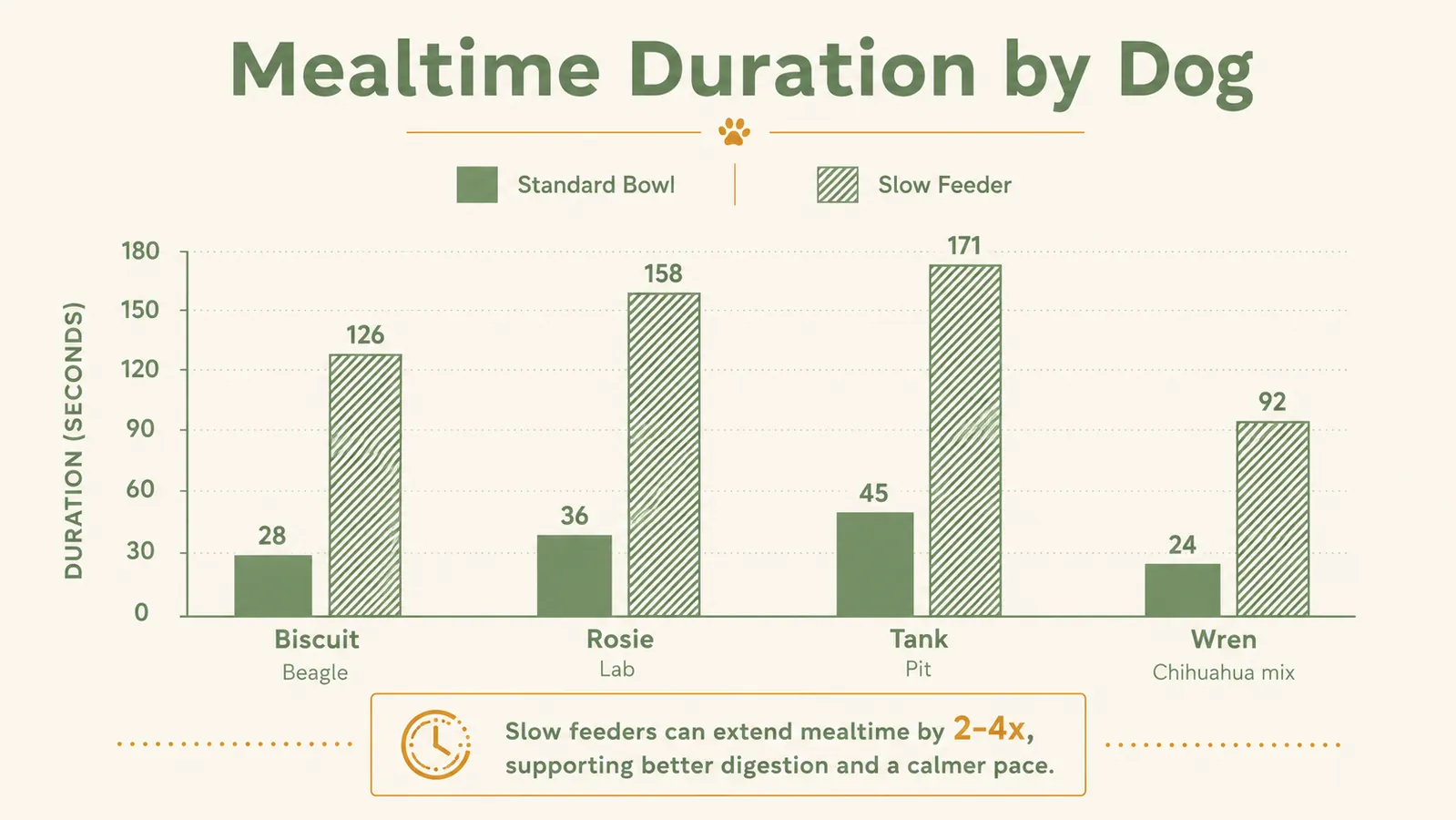
Tank flipped the bowl four times in six weeks. He is not a frustrated eater and he was not doing it out of spite. He is just a big, enthusiastic dog and the bowl is light plastic. When he pushed his muzzle into the edge of the bowl to reach kibble, the bowl tipped. Kibble scattered. He ate it off the floor in three seconds.
The bowl does not have a suction cup base, which is the standard fix for this problem. Outward Hound makes a version with a suction base but it is a different product. The Fun Feeder Slo Bowl relies on weight-in-bowl to stay put. For a 28-pound Beagle, the bowl weight plus kibble is enough friction against the floor. For a 62-pound dog eating on tile, it is not. If you have a large, enthusiastic eater, look at the version with the suction ring, put a rubber placemat under the bowl, or plan to supervise the first few meals to see whether your dog moves it.
Rosie never flipped it, for what it is worth. She ate methodically with less lateral force. Biscuit never came close. The flipping issue is dog-specific, not a universal flaw, but it is predictable: if your dog is a pusher, you need the suction version.
What the Bowl Does Right
The core function works. For Biscuit and Rosie, the bowl turned a 30-second inhale into a 3-to-4 minute meal. That is a meaningful difference. Slower eating means less air swallowed, which reduces the bloat risk and the gas that comes with it. Both dogs were calmer after meals on the slow feeder than they were before. Biscuit used to pace after eating, which vets associate with discomfort from swallowed air. That stopped in week two and did not return.
The bowl is also just a genuinely good value. The price is under ten dollars. It is BPA-free, dishwasher-safe, and it holds up. At that price point, the question is not whether the tradeoffs are worth it. They almost certainly are. The question is whether you know what the tradeoffs are before you buy.
What I Liked
- Dramatically slows medium-sized and most large dogs at mealtime (3-4x longer for Biscuit and Rosie)
- Dishwasher-safe and holds up to repeated cycles without warping when used on top rack
- BPA-free food-grade plastic, no odor or film buildup over six weeks
- Under ten dollars, widely available, and ships fast via Prime
- Over 134,000 Amazon ratings at 4.6 stars, broad owner validation
Where It Falls Short
- Grooves require a bottle brush or dishwasher to clean properly, sponge-only leaves residue
- No suction base: large, enthusiastic dogs can flip the bowl mid-meal
- Wide-muzzled dogs (Pit bull types, Bulldogs) may not get full benefit from the groove depth
- Medium size is too large to meaningfully slow very small dogs under 15 pounds
- Maze difficulty is fixed, so determined dogs may solve it faster over time
Who This Is For
This bowl is for medium-sized dogs between roughly 20 and 55 pounds with a standard or narrow muzzle who inhale food in under a minute. If that describes your dog, the Fun Feeder will almost certainly do exactly what it claims. It will slow them down, reduce air swallowing, and give you a calmer post-meal dog. At under ten dollars it is one of the cheapest, most well-validated tools in the pet feeding space. Pair it with a rubber placemat if your dog is a mover.
It is also worth considering if you have a dog prone to post-meal bloating or one who vomits shortly after eating because of speed. A vet should still be in that loop, but slowing the meal is a legitimate and low-cost first intervention that many vets recommend. If you want to read more about why dogs eat fast in the first place, our piece on the 10 reasons your dog eats too fast covers the behavioral and health factors behind it.
Who Should Skip It
Skip this specific bowl if your dog weighs under 15 pounds, if your dog has a very wide muzzle (Bully breeds, English Bulldogs, Boxers), or if your dog tends to flip or push their bowl across the floor. For the bowl-flipper: look at the Outward Hound version with a suction base, or the Outward Hound Fun Feeder Mini for genuinely small dogs. For the wide-muzzle dog: a licki mat with wet food spread across it will give you more surface area without the groove-depth problem. Our comparison of slow feeder bowl vs licki mat walks through which tool is better suited to which dog.
Also skip it if you are not willing to clean it properly. I know that sounds obvious but the one-star reviews are full of people who rinsed the bowl once, smelled something off, and blamed the product. If you hand-wash, use a bottle brush. If you have a dishwasher, use it on the top rack. That is the maintenance contract.
Stop the 20-second meal before it becomes a vet visit.
The Fun Feeder Slo Bowl is one of the few products at this price point that does exactly what it says for the dogs it is designed for. If your dog is in the right size range and eats too fast, this is the straightforward fix. Check today's price on Amazon and see the full range of maze patterns available.
Amazon Check Today's Price on Amazon →