
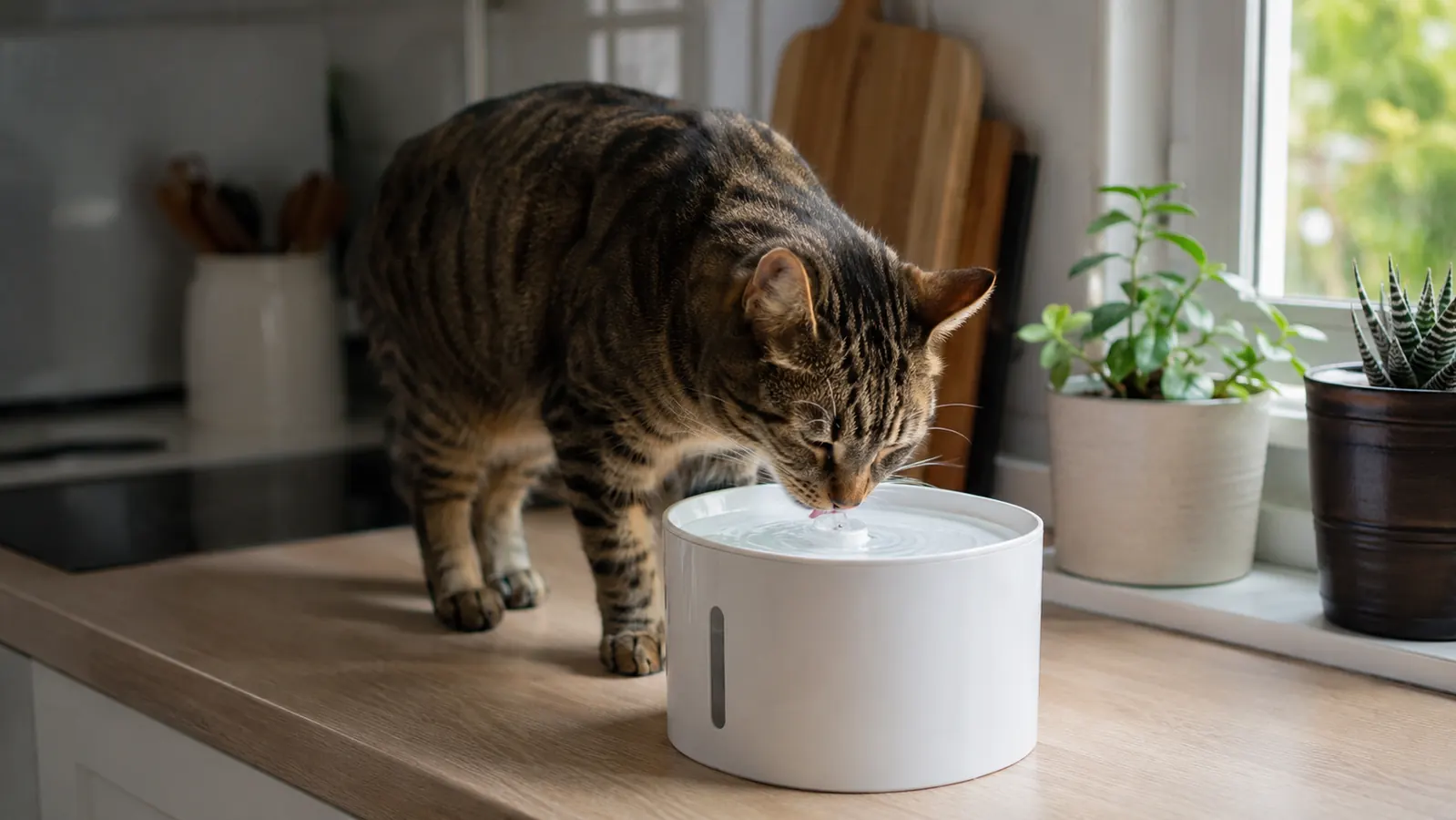
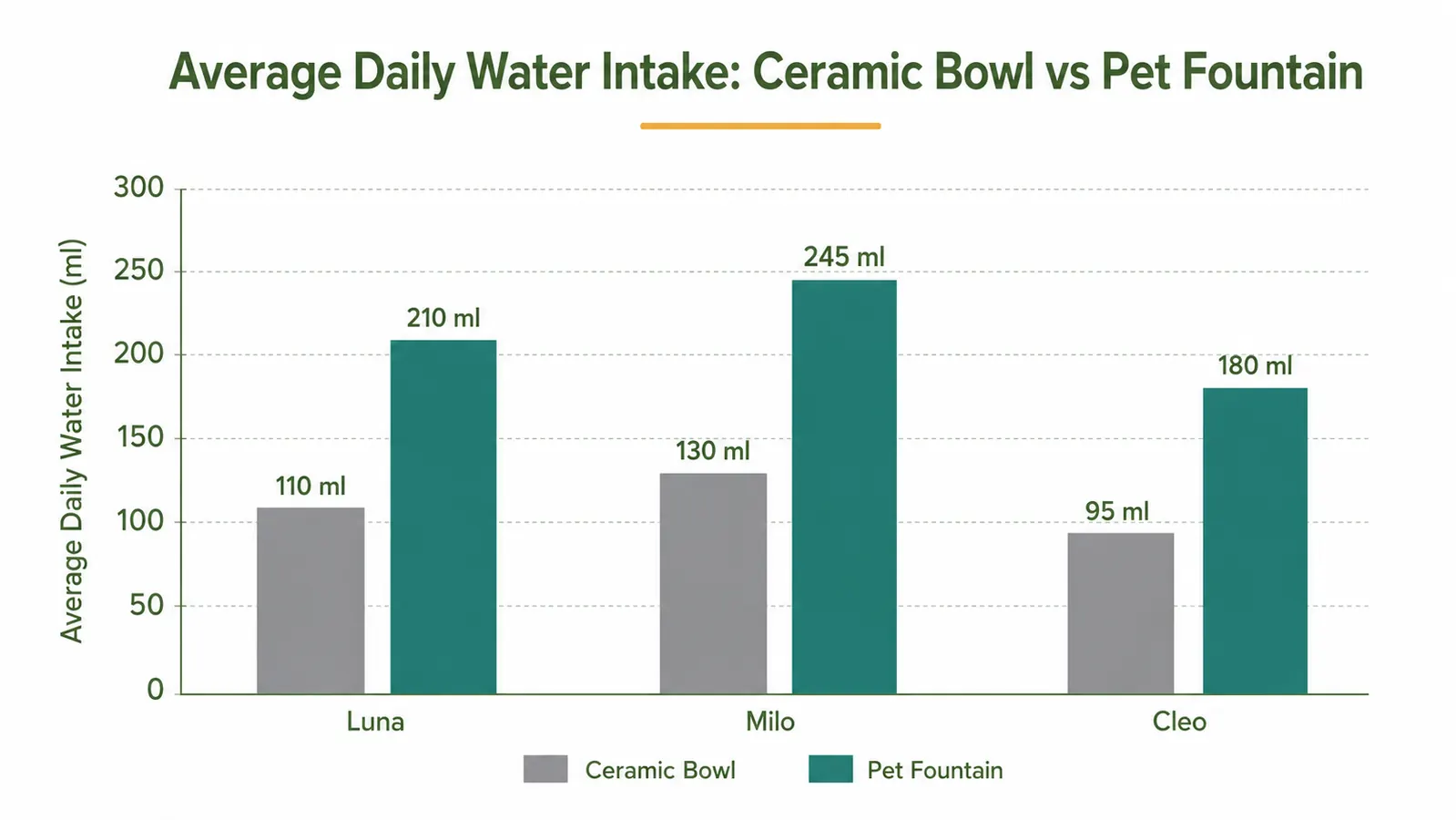
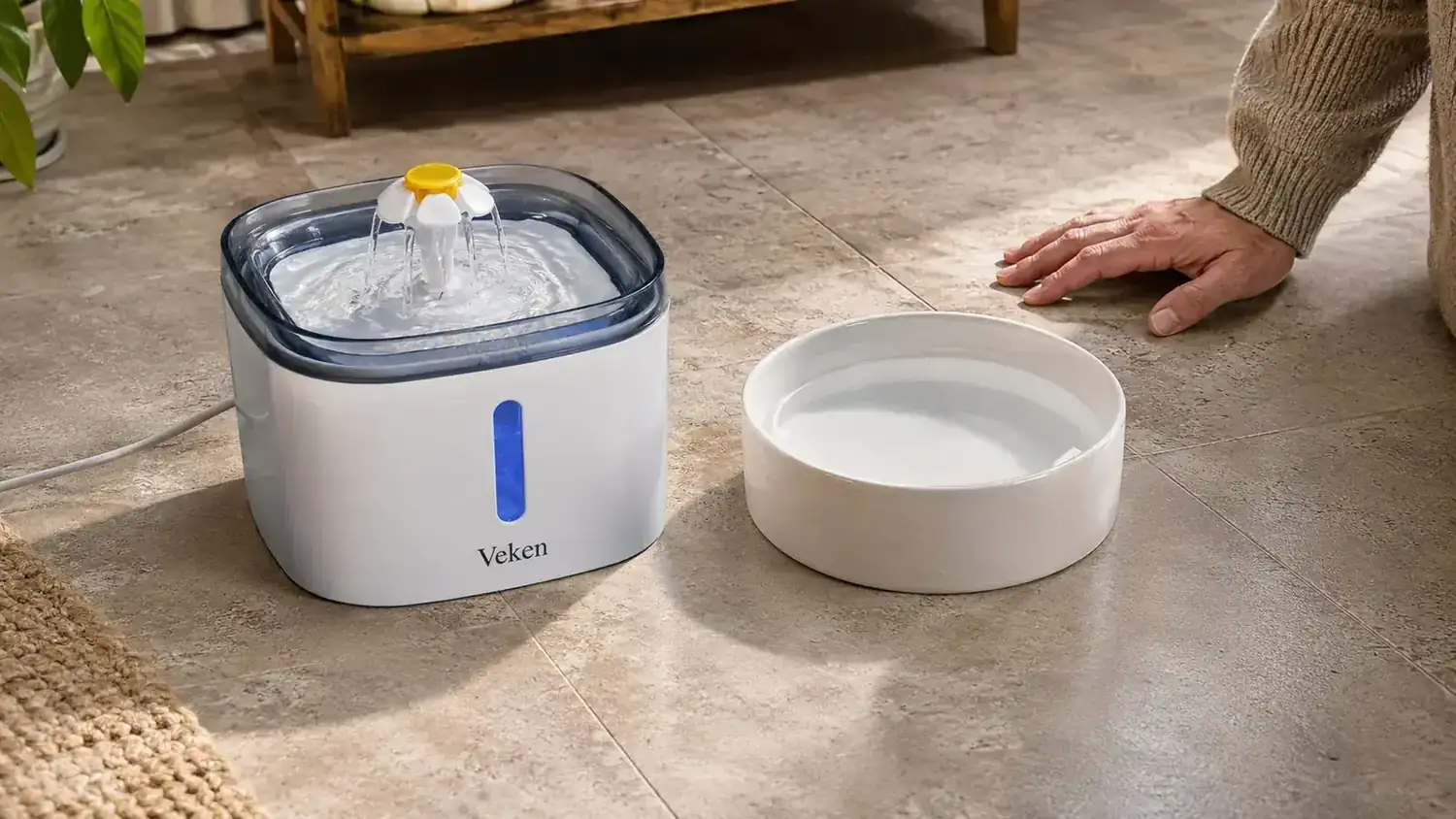
Short answer: the fountain wins, and it is not particularly close. Over four weeks I tracked water intake for my three cats, Fern (5-year-old tortoiseshell), Grip (3-year-old gray shorthair), and Della (8-year-old calico), alternating seven-day stretches on a standard ceramic bowl versus the Veken 95oz pet fountain. Every single cat drank more from the fountain. The gap was smallest for Grip, who drinks reasonably well regardless. It was largest for Della, who spent the bowl weeks barely touching her water and racked up two vet visits for urinary issues before I got serious about this comparison.
That said, a ceramic bowl is not nothing. It has real advantages in certain situations, especially for cats who are anxious about new equipment or for owners who want zero ongoing maintenance costs. This article lays out exactly where each option holds up and who should buy which.
| Pet Fountain | Ceramic Water Bowl | |
|---|---|---|
| Capacity | 95 oz (2.8 L) -- fills once every 2-3 days for a two-cat household | Typically 12-20 oz, needs daily or twice-daily refills |
| Filtration | 3-layer carbon + foam filter included, replacements ~$8 for a 4-pack | None -- water sits open to air, dust, and pet hair |
| Circulation | Constant circulation via quiet pump (rated <40 dB) keeps water oxygenated and cool | Static water, no movement, no oxygenation |
| Cleaning | Top-rack dishwasher safe (minus pump); full disassembly takes about 3 minutes | Dishwasher safe; 30-second rinse is usually enough day-to-day |
| Upfront Cost | Moderate -- check today's price on Amazon | Low -- a quality ceramic bowl runs $8-$18 |
| Ongoing Cost | Replacement filters every 2-4 weeks, roughly $2 per filter | None beyond water |
| Noise Level | Nearly silent when water level is kept above the minimum fill line | Silent |
| Cat Acceptance | Most cats accept it within 48 hours; curious cats investigate immediately | Zero adjustment period -- cats already know what a bowl is |
| Best For | Cats prone to UTIs, kidney disease, or low water intake; multi-cat homes | Cats who drink well regardless, travel situations, minimalist setups |
Where the Veken Fountain Wins
The biggest win is behavioral. Cats are instinct-driven drinkers. In the wild they avoid still water because standing pools are more likely to carry bacteria and parasites. Moving water signals fresh, safe, and good to drink. That instinct does not disappear just because the water comes out of a municipal tap. All three of my cats approached the Veken fountain with immediate curiosity on day one. Fern started drinking within twenty minutes of first setup. The ceramic bowl weeks saw Fern visit the water station roughly three times per day. During the fountain weeks she visited it six to eight times.
The filtration is also a real factor. Over a 24-hour period, a standard ceramic bowl in a typical home collects dust, pet hair, and whatever floats through the air in the kitchen. I noticed my cats often sniffed the ceramic bowl and walked away without drinking, especially by the end of the day. The Veken's carbon filter pulls those particulates out and the constant circulation prevents bacterial film from building up on the sides. Whether your cats can smell that difference or simply respond to the visual signal of moving water, the outcome is the same: they drink more.
For Della specifically, the 8-year-old who has dealt with recurrent urinary tract issues, the difference was not subtle. During the two ceramic-bowl weeks she drank an estimated 40-50 ml per day based on refill measurements. During the fountain weeks that jumped to 90-110 ml. Her vet has told me more than once that chronic low water intake is the primary driver of her UTIs. This was the comparison that convinced me the fountain is permanent in my house.
Where the Ceramic Bowl Wins
Maintenance is the honest argument for a ceramic bowl, and it is worth saying plainly. The Veken fountain needs filter changes every two to four weeks, full disassembly for scrubbing every week or two, and occasional pump cleaning to prevent algae buildup in the base reservoir. If you have a packed schedule and know you will skip those steps, the fountain will become a bacteria trap faster than a static bowl would. A ceramic bowl you rinse daily and run through the dishwasher twice a week is cleaner in practice than a fountain you maintain lazily.
Travel and simplicity also favor the bowl. If you are boarding your cats, having a pet-sitter come in, or moving households, a ceramic bowl requires zero explanation and no power outlet. The Veken fountain needs to stay plugged in or the pump stops and the water goes stagnant faster than a static bowl would. For short trips or transient living situations, the bowl wins on practicality alone.
If your cat under-drinks, the Veken fountain is the practical fix most vets quietly recommend.
The 95oz capacity, three-layer filtration, and near-silent pump make it the easiest upgrade you can make to your cat's daily hydration. Over 49,000 Amazon reviews back that up.
Amazon Check Today's Price on Amazon →The Maintenance Reality: A Candid Look
I want to be straight about the fountain's one real downside because it shows up in the negative reviews and it is legitimate. If you let the water level drop below the pump intake, the motor runs dry and gets noisy. A low whirring sound starts up and it is annoying. The fix is simple (top it off), but if you have a busy week and forget, it happens. I have done it twice in several months of use. Neither time caused lasting damage, but it is a real friction point that the ceramic bowl simply does not have.
Filter replacement is the other ongoing task. The included filters are rated for about two to four weeks depending on how many cats use the fountain and how much hair and debris they bring to the water station. I run two cats through it most of the time and change the filter every three weeks. Four replacement filters cost around eight dollars on Amazon, so the annual cost works out to roughly fifteen to twenty dollars for filters. That is not a dealbreaker, but it is a real number to know before you buy.
Every cat I have ever had drank more from moving water than from a bowl. It took me years and two UTI scares to finally take that seriously.
Who Should Buy the Veken Fountain
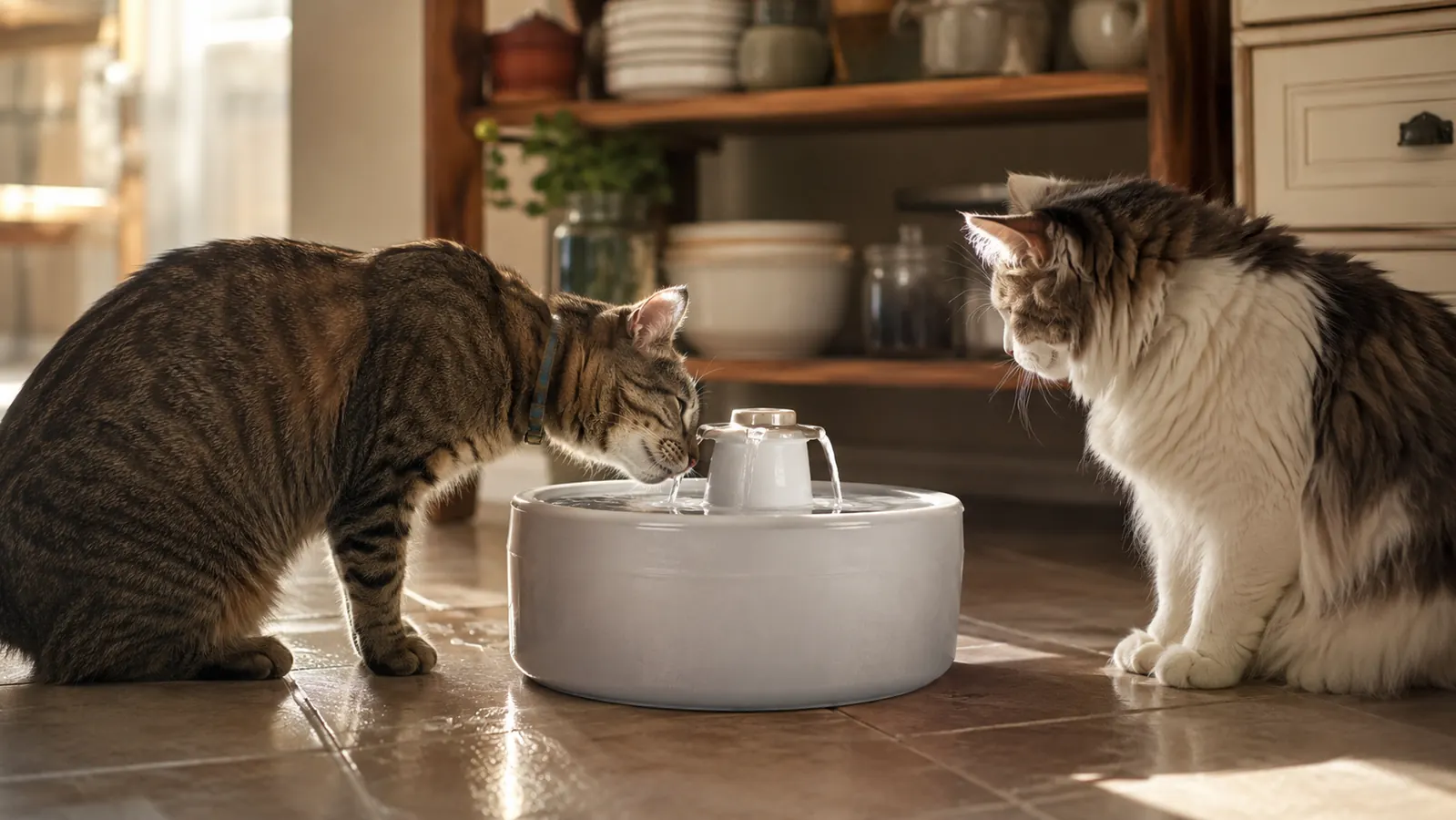
Buy the Veken fountain if your cat has a history of UTIs, kidney stones, or any diagnosis where your vet has told you hydration matters. Buy it if you have a cat who ignores the water bowl, visits it briefly and walks away, or drinks noticeably more from a dripping faucet. Buy it if you have two or more cats sharing a single water station, since the 95oz capacity and constant filtration handle multi-cat use far better than a small ceramic bowl does. And buy it if you want to do something proactive for your cat's long-term kidney health without waiting for a problem to develop. For most cat owners, the fountain is the better default. You can read a full year-long breakdown of how it performs over time in our Veken pet fountain long-term review.
Who Should Stick With a Ceramic Bowl
Stick with a ceramic bowl if your cat drinks perfectly well already and has clean bloodwork every year. Stick with it if you travel frequently and your care setup does not support a plugged-in appliance. Stick with it if you have a skittish cat who is already stressed by new objects in the environment and a fountain introduction would add more anxiety than the hydration benefit is worth. And be honest with yourself about maintenance: if you know you will not keep up with weekly disassembly and filter changes, a well-rinsed ceramic bowl is cleaner in practice than a neglected fountain. If you are trying to get a picky cat drinking more without a fountain, the tactics in our guide to getting cats to drink more water cover several options that work without any new equipment.
Ready to see if moving water changes how much your cat drinks? The Veken is the easiest test.
Set it up in twenty minutes, run it for two weeks alongside your existing bowl, and see which one your cat gravitates toward. The fountain comes with three replacement filters so you are covered for the first month without a separate order.
Amazon Check Today's Price on Amazon →